
The first thing you notice at the Dave & Buster’s in Hollywood, Florida, isn’t the arcade noise or the glow of the screens — it’s the flags. Blue and red banners are draped over shoulders and tabletops, fans are chanting in Kreyol (the phonetic spelling of Haitian Creole in the language itself), and families who have never met are high-fiving like old friends as Haiti’s national team walks onto the field for its first World Cup appearance in more than 50 years.
For Vania Andre, editor-in-chief of The Haitian Times, the Brooklyn-based outlet that helped organize this and dozens of similar watch parties around the country, the World Cup was never just about soccer. In partnership with the Federation of Haitian Chambers of Commerce (FHCC) and Dave & Buster’s, the newsroom used the tournament to create spaces where Haitian Americans could gather, celebrate their culture, and see their country represented in a rare, joyful light.
In the face of what Andre described as rising opposition to diversity in the United States, The Haitian Times and its collaborators set out to use the World Cup as a positive global frame for Haiti. At the same time, the project offered something more quietly radical: a blueprint for how local and diaspora media can build community, attract sponsors, and claim control over how their communities are seen on the world stage.
These watch parties came on the heels of two years of planning after an Atlanta stop on the Times’ nine-city listening tour across the U.S., where the idea for further collaboration between the different chambers of commerce was initially floated. Ronald Cetoute, the former president of the Georgia Haitian-American Chamber of Commerce, helped cement the partnership after the Haitian Community Summit in Indiana last year and the formation of the FHCC.
“That was the crucial part in helping this thing happen,” Andre said. “That we had partners across the country in various cities that we would be able to tap into.”
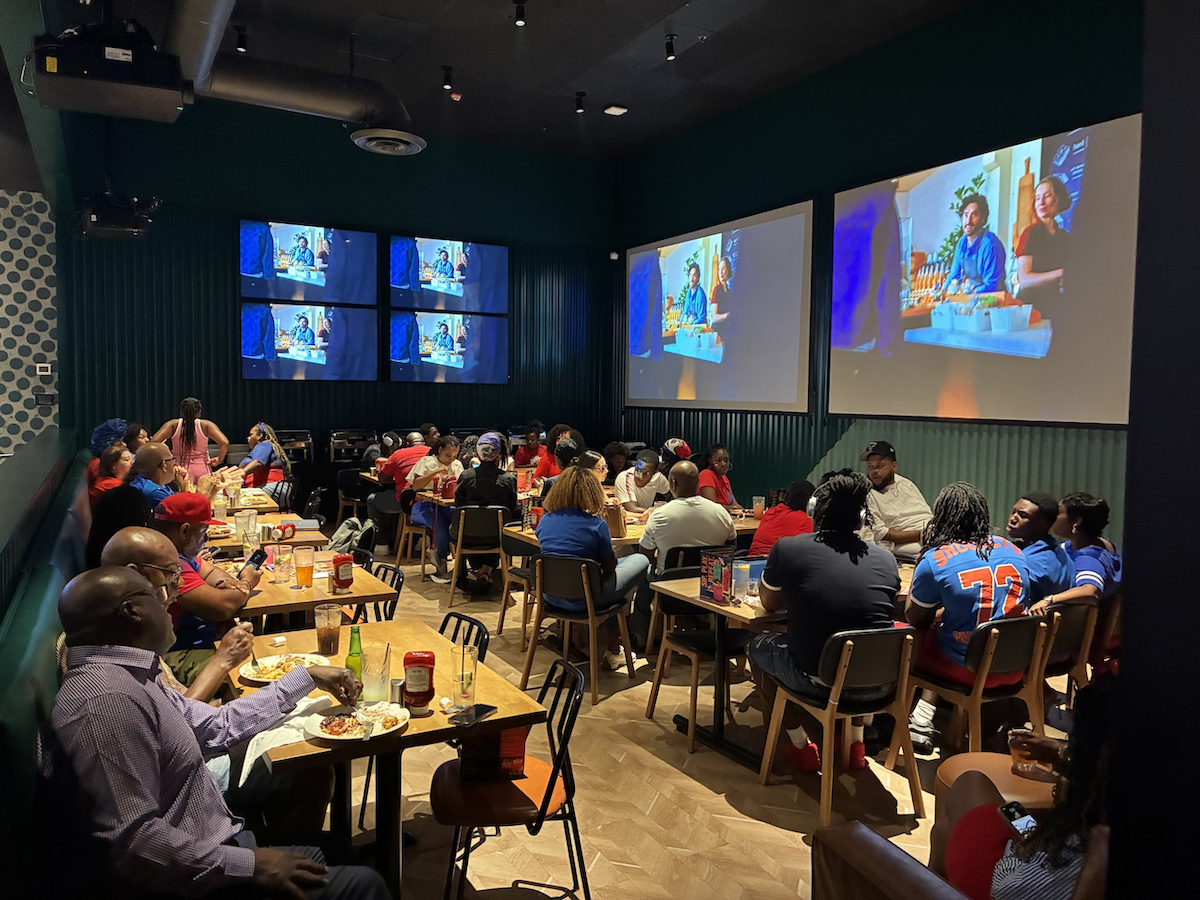
The project was initially set to partner with Haitian restaurants around the U.S. for its watch parties, but they found an unlikely partner in Dave & Buster’s when a regional manager in Florida reached out to a Times reporter in hopes of getting coverage on a watch party they were putting together for the Haitian national team’s qualifying games.
After eliciting positive feedback from readers about the parties, Andre brought the idea of further collaboration with Dave & Buster’s to the regional manager, where they embarked on a two-week frenzy to identify Haitian markets with a chamber partner close by that would be willing to join in on the idea for the World Cup without competing with already existing markets.
“We particularly focused on those markets where new Haitian families are coming, but they don’t necessarily have the infrastructure, so we [could] provide a family-friendly area for them to be able to watch these games,” Andre said.
The overarching aim was to give attendees a space to convene together and “just kind of exist,” as Andre put it. She highlighted the rapid disappearance of family-friendly “third spaces” where Haitians could gather, celebrate, and see themselves represented.
Planning discussions centered on the resourcefulness of the team, which never got to practice together in their home country in preparation for the tournament. And the incorporation of Vodou and revolutionary symbolism in early designs of the team jerseys came to characterize the narrative power of the moment for the Times.
“The framing of the story is not about the political disasters,” Andre said. “This is one of the few times we get to talk about Haiti and Haitians in a positive light, and that was very intentional and important for us as a news organization.”
Early feedback from the series of watch parties suggests that the promotion has resonated deeply with attendees. Andre said some attendees were so enthused that Dave & Buster’s recognized this moment and made space for families to congregate that they considered adding the establishment to their regular entertainment routine.
“Folks were really excited to see, honestly, that Dave and Buster’s, as a brand, was cognizant and aware of how much of a monumental moment this was for us,” she added.
In an era when many companies are pulling back from diversity and inclusion efforts in their marketing and branding materials, Andre emphasized that carving out a safe environment for people to freely express themselves makes financial sense above all.
“This is a very specific market that is an opportunity for [businesses] to increase their sales,” Andre said. “Black people specifically have a lot of buying power … so it’s in everyone’s best interest to be welcoming and inclusive so that we feel valued, safe, and want to spend dollars at your establishment.”
One of the core elements behind the methodology of these parties and coverage was to show how integral diaspora publications are to the media landscape as a whole — despite being frequently overshadowed in mainstream culture.
“There’s this misconception that each community does not have their own media, which is so far from the truth,” Andre said. “Every single immigrant group has their own media apparatus to help tell their narratives.”
The Haitian Times itself is symbolic of the mosaic that comprises the Haitian experience, she added, including those who were born and live in Haiti and others who were born or live elsewhere across the diaspora.
Overall, Andre sees these events as a proof of concept for future connections by local media. What happened in a few weeks with The Haitian Times, the FHCC, and Dave & Buster’s, she argues, is something other local and diasporic newsrooms can copy.
For newsrooms facing shrinking budgets and fraying trust, the World Cup watch parties offer less of a feel-good anecdote than a model for marketing to those closest to your core base.
“Support everyone. Support community and diaspora media… New York City alone has 300 community and ethnic media outlets,” Andre said. “We exist, we’re here, and the World Cup is an excellent opportunity for us to remind folks that we exist.”
Tags: Haitian Times, Media Marketing