
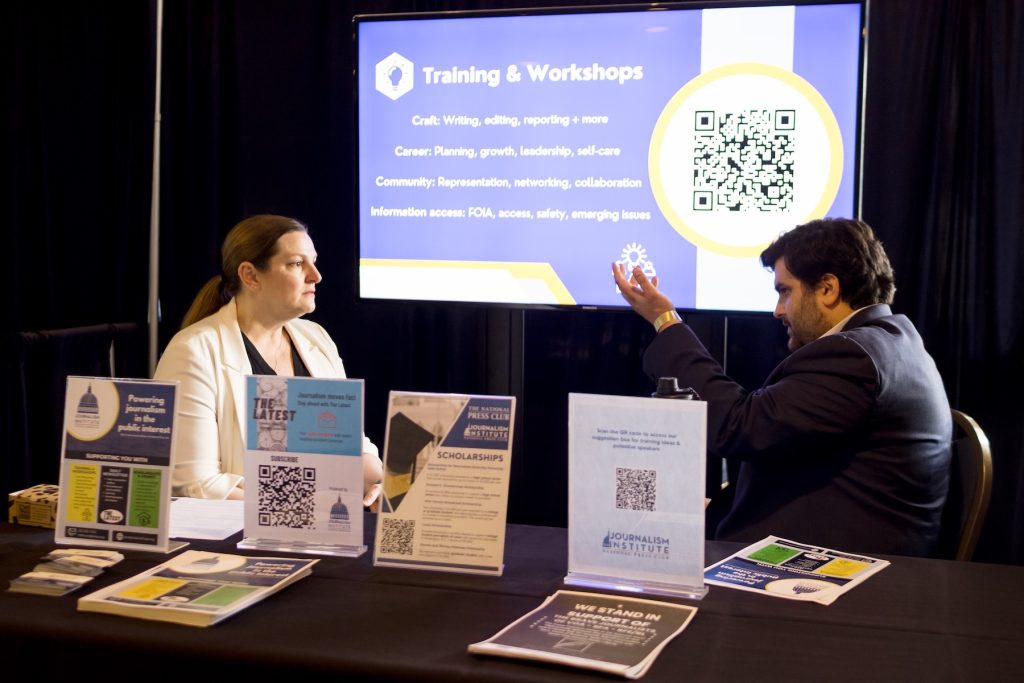
Nearly 400 people attended Career Day at the National Press Club on Friday for a packed day that included complimentary professional headshots, networking with recruiters, and training opportunities provided by the National Press Club Journalism Institute.
Recruiters included:
- American City Business Journals
- American University School of Communication
- The Associated Press
- C-SPAN
- CQ Roll Call
- Craig Newmark Graduate School of Journalism at CUNY
- Philip Merrill College of Journalism at The University of Maryland
- POLITICO
- Report for America
- State Affairs
- States Newsroom
- URL Media
- USC Annenberg School for Communication and Journalism
- Washington Examiner
- Washington Intern Student Housing (WISH)
- + others


(All photos by Alex Polyakov)
The event’s training sessions offered key information for journalists and media professionals who are stuck in the job search or needed a refresher on the basics. Additional workshops were hosted by URL Media throughout the day.
NPCJI sessions included:
- Cover Letter Strategies
- What Hiring Managers Want You to Know
- Building Your Brand as a Journalist or Media Professional
- Winning Job Search Strategies.
Highlights from each session are below.
Cover Letter Strategies
NPCJI Executive Director Beth Francesco kicked off the day with a crash course on all things cover letter.
“Cover letters let you articulate — far ahead of an interview — your value proposition for the organization you’re approaching with an application,” Francesco said.
Many jobs and fellowships have hundreds of applicants with similar skill sets vying for them, so “it’s important to figure out and articulate what you as a unique individual are bringing to the organization and your relevance within that space,” Francesco added.
Effective letters have three key components:
An engaging opener
Every journalist knows the importance of a strong lede — so why don’t we apply that knowledge when we tell and sell our own story?
It’s often an opportunity missed. And it’s made even more important when you consider the average attention span of a human: just 8 seconds! If you are starting with “My name is Beth Francesco, and I’m applying for …” you may be missing a moment.
A clear pitch
This is where you get to sell yourself for the role and how you are uniquely qualified for it. While you may have similar experiences as other applicants, this is a chance to highlight specific instances where you’ve connected with a source or written something that influenced legislation. You have done things that have had an impact. The cover letter is a way to reflect these actions and how they are relevant to the organization you’re applying to.
A confident closer
It’s perfectly fine to close with a simple “Thank you for your consideration.” But more confident ways to say that could be: “I look forward to connecting to discuss the position,” or, “I’d love to schedule a time to speak with you about how I can contribute to the team.” Avoid closing with anything that sounds like a burden to the reviewer: i.e. “Please contact me for references.”
Francesco continued by sharing examples from job applicants who drew on conversations with recruiters, a familiarity with the organization’s goals, and relevant experiences to avoid “resume redundancy.”


What Hiring Managers Want You to Know
A second session for job seekers focused on what makes someone a “great” applicant at top news organizations, with insights from recruiters and editors responsible for hiring staff, including:
- Tim Lampley, recruitment manager at Report for America
- Jane Norman, Washington Bureau Chief of States Newsroom
- Jackie Ramsay, talent acquisition manager for POLITICO
- Vandana Sinha, Regional editor for American City Business Journals
Here are some key pieces of advice from the panelists:
Don’t limit yourself to major media markets
“You can be a really big fish in a smaller market and really learn a lot because you’re doing a lot of things, you’re covering a lot of ground, and you’re learning a lot of skills that you have to in a smaller market,” said Vandana Sinha, of American City Business Journals, which has 44 publications across the country.
“Very rarely do we have openings in those bigger markets [New York, Chicago, D.C., and L.A.]. We have a lot of openings in those smaller markets. If you’re mobile and willing to move and learn, it’s a great way to learn a beat and a whole new area. Even if you’ve never been there before, it’s totally fine. You bring a fresh eye.”
Follow up with a recruiter or hiring manager if you haven’t heard back from them (in certain situations)
“I think it depends on where you are in the process,” said Jane Norman, of States Newsroom. “Let’s say you’ve gone in for an interview. You’ve actually been in the office, you’ve spoken to the editor, maybe you’ve spoken to the HR people. I think that’s a different situation than if you’re one of a hundred applicants and you haven’t heard anything back. In the first place, it’s fine to contact [the hiring manager] and say, ‘Are you still hiring for this job?’ But if you’ve had an interview or two, and you are in the process and don’t hear from somebody for two, three, four weeks, you are absolutely within your rights to email whoever you interviewed with and ask for a timeline as to how much longer you should wait.”
You don’t need to meet every job requirement to throw your hat in the ring
“I think if you have 50% to 60% of the requirements on the posting, you should go for it. Honestly, if you’re interested, just go for it anyway,” said Jackie Ramsay, with POLITICO. “A lot of skills are transferable. When I’m hiring policy reporters on the Hill, a lot of my editors are looking for two things: You know your way around the Hill or at a state government level; and familiarity with policy. It doesn’t even have to be the specific policy area you’re applying to. So I think if you have the broad strokes of what the job is asking for, you don’t have to be as specific as what it’s asking for. I think you should still just go for it.”
You can network with newsroom leaders and hiring managers as a freelancer
“I think a good idea is for you to do some research,” said Tim Lampley, with Report for America. “Target newsrooms that you’d like to work for. And if you’re attending events like this or any conventions, reach out to people directly if you know that they’re going to be there, and set up a breakfast with a newsroom manager or someone you’d like to freelance with, as opposed to standing in that long line to get to talk to them … You have to be really focused on what you’re looking for, and then find the people that can help you.”
Sinha added that there are communities, newsletters, and networks that can help freelancers find opportunities, and that freelancing for different outlets can be a great way to build clips. It’s also a way for editors to get to know your work as a potential staff member.


Building Your Brand as a Journalist or Media Professional
Philip Lewis, deputy editor at HuffPost and president of the Washington Association of Black Journalists, built a journalism career after going viral on Twitter (now X) and becoming a reliable news source across several platforms.
Lewis’ brand has expanded to include a Substack with over 34,000 subscribers, a podcast, and accounts on emerging platforms like Bluesky, where he’s already amassed more than 360,000 followers. Lewis shared some practical tips for growing your audience and building your brand, including:
Collaborate with news aggregators or social media pages that already have a large following
Influencer accounts often repost screenshots of stories originally reported by professional journalists and add their own commentary. As the journalist who produced the original content, Lewis recommends requesting that those accounts tag you and mention your byline in the caption to credit you for your hard work.
As an example, Lewis mentioned local news aggregator and meme page Washingtonian Problems as an account that journalists in the D.C. area should reach out to when they have a story soon to publish. “Sometimes, as journalists, we clash with influencers,” Lewis said. “But I think that there are ways that we can partner, because they’re there. They’re not going anywhere.”
Use email lists to build a loyal audience
Lewis has collected an email list through Substack — it’s a list of readers he could reach quickly if he were to lose his full-time journalism job. Email lists “are something they can’t take away from you,” Lewis said. “It cuts out the middleman … You can have a million followers on social media, but if TikTok decides they don’t want you on their platform anymore, you’re done.”
Consistency is key
“If I wasn’t up here right now, I’d probably be tweeting something out,” Lewis joked. “If I’m gone for a day [on social media], people might ask, ‘Hey, nothing happened today?’”
Lewis recommends carving out specific time in your calendar each week to work on brand building — whether that’s posting to social media, editing your blog, or recording your podcast on the week’s news on your beat. Lewis, for example, has published his newsletter every Friday since 2023, meaning his readers know exactly when to expect it in their inbox. You don’t have to wait for someone to give you your big break — starting now and staying consistent will help you build a network and portfolio you can share with potential employers.
Winning Job Search Strategies
Andrew Seaman, editor-at-large for jobs and career development at LinkedIn News, shared current industry trends and tips for making yourself a more viable candidate.
“I still really do believe in the idea that we don’t have to be miserable at work,” Seaman said. “We might be … but there are things we can do to find something that makes us less miserable or even content. I don’t believe that you should love your job. But you should be able to show up at your job and not hate it.”
In order to find a job that meets that criteria, Seaman offered the following advice:
Focus on skills, not titles
“We are rapidly approaching a world where what you can do is more important than what you call yourself,” Seaman said. “The benefit of this for job seekers is that it opens a world of possibilities beyond what they would normally consider.” Thinking of which skills you want to maximize or minimize, and which skills you need for the jobs you’re applying for will help you avoid restricting yourself to one profession.
Identify your target
There’s the “spray and pray” method of applying to jobs where you send out as many job applications as possible and hope one lands in the right spot. “No one I’ve ever talked to on the hiring side advocates for that,” said Seaman. People often wonder whether they should apply to jobs that show more than 100 LinkedIn users have applied to it already. Seaman tells people they should apply to those jobs if they’re truly interested because most of those are applications from people who have no interest in that job or industry. “The more specific you can get, the more time you get to focus on the quality of that application to cut through that noise,” Seaman said.
Find community
Seaman produces the Get Hired newsletter and podcast on career growth, and says he gets the most positive feedback on his advice about finding a job search club. These informal groups have been around for decades and help people find community with other job seekers.
Job search clubs tend to result in better mental health and more successful application processes for members, Seaman said. They typically involve an agreement that the group won’t disband until everyone in it has found work, as well as weekly discussions around topics like resumes and common issues they’re facing. Seaman shared some tips for how to find a job search club on his newsletter.
More photos from Career Day


Founded in 1908, the National Press Club is the world’s leading professional organization for journalists. With 3,000 members from nearly every leading news organization, the Club is a leading voice for press freedom in the U.S. and worldwide.
The National Press Club Journalism Institute promotes an engaged, global citizenry through a free and independent press and through programs and trainings. NPCJI is the nonprofit affiliate of the National Press Club.