
By Allaa Azzam, NPCJI Press Freedom Fellow
Journalists covering demonstrations, courthouse detentions, and Immigration and Customs Enforcement (ICE) related activity must increasingly learn how to navigate confrontations with law enforcement, equipment seizures, attempts to block filming while reporting in public spaces, and even detention while carrying out their newsgathering.
While U.S. laws generally protect journalists’ right to report freely in public areas, press freedom organizations have documented cases where those protections were violated during fast-moving situations on the ground.
To better understand how journalists can prepare for these assignments safely, the National Press Club Journalism Institute spoke with veteran conflict reporter and journalism safety trainer Judith Matloff.
Matloff teaches hostile environment reporting at Columbia University’s Graduate School of Journalism. She has trained journalists covering wars, civil unrest, protests, and politically tense situations around the world, and is the author of “How to Drag a Body and Other Safety Tips You Hope to Never Need.”
Proper preparation can significantly reduce one’s risk once events begin to escalate, Matloff stressed. Read her key recommendations for journalists before they cover a protest, immigration enforcement action, or similar event:
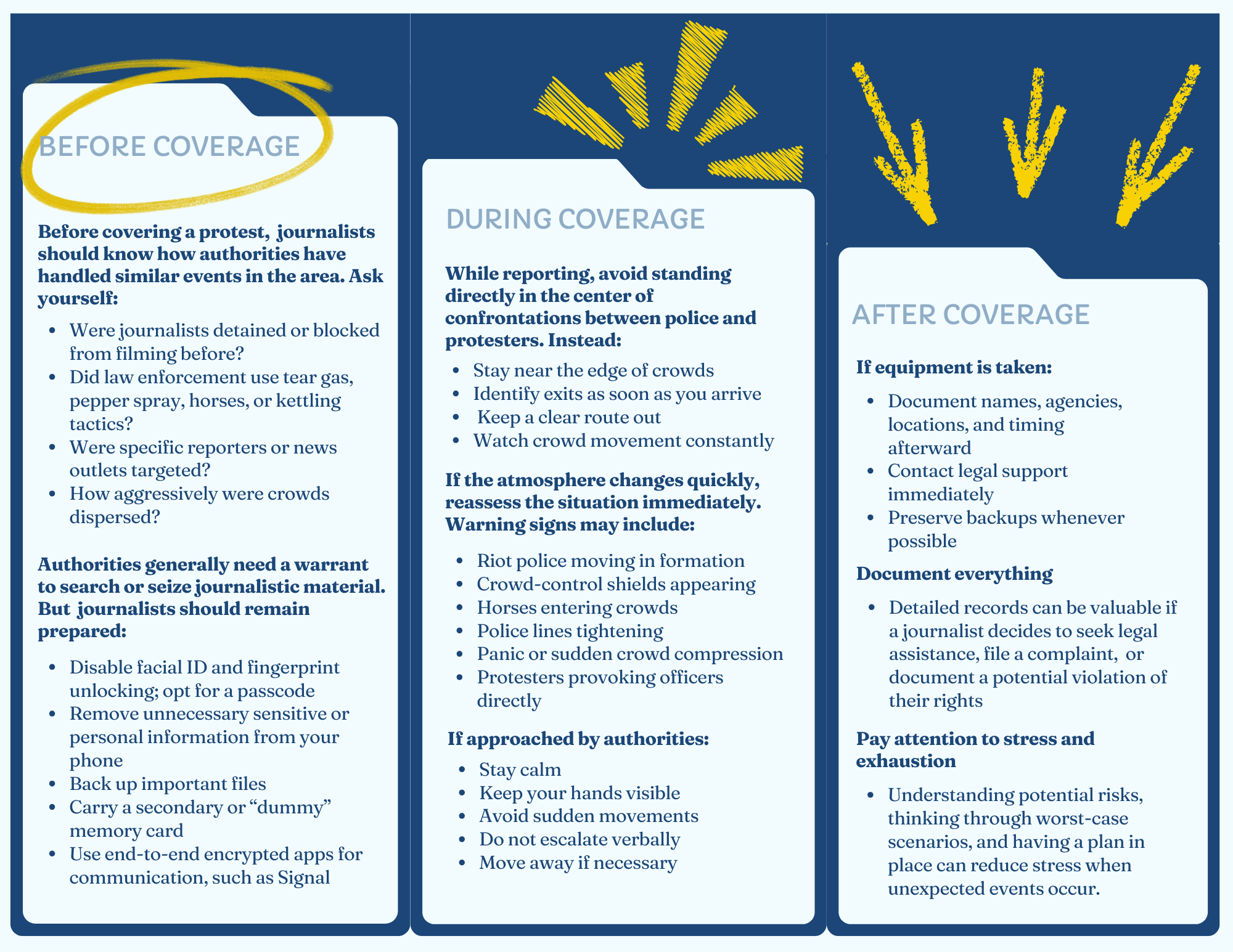
Before coverage
Before covering a protest, rally, or immigration enforcement operation, journalists should know how authorities have handled similar events in the area.
“The first thing you need to do is look at the patterns,” Matloff said. “What has law enforcement or ICE done in the past in your region? If you know they have violently pulled people out or thrown members of the press to the ground before, that can help orient you as to what sort of strategy you should take.”
Questions journalists should ask include:
- Were journalists detained or blocked from filming before?
- Did law enforcement use tear gas, pepper spray, horses, or kettling tactics? (Kettling tactics include surrounding and containing crowds to restrict movement and access to exits)
- Were specific reporters or news outlets targeted?
- How aggressively were crowds dispersed?
Researching these patterns can help journalists assess the level of risk they may face and determine what precautions they should take before arriving.
“Do not walk into these situations blindly,” Matloff said.
It’s equally important that journalists let colleagues know their whereabouts and, whenever possible, not report alone:
- Work with another reporter, producer, or crew member.
- Share your location with someone you trust.
- Make sure someone has your emergency information.
- Decide who should be contacted if you are detaine
A reporting partner can help monitor crowd movement, identify exits, and contact editors, lawyers, or family members if something goes wrong. This becomes especially important when a journalist is filming and focused on events unfolding in front of them.
“When you’re filming, you can’t see what’s happening behind you,” Matloff said. “You need somebody watching your back.”
A partner is also vital in cases of detention. “In case something happens to you, that person can call your editor or call your lawyer,” Matloff said.
Prepare legal support in advance
Before coverage:
- Save the number of a lawyer or legal support organization. NPCJI recommends the Reporters Committee for Freedom of the Press if you do not already have local legal assistance. RCFP has a legal hotline: (1-800-336-4243).
- Clarify your news organization’s procedures in case of detainment or arrest.
- Carry emergency contact information physically, not only digitally.
- Decide who should receive an emergency phone call.
Matloff recommends making these decisions before arriving on scene rather than trying to make them while dealing with an emergency. She also recommends deciding in advance who should receive an emergency phone call if a detention occurs.
“If you’re arrested, you’re only going to get one phone call normally,” Matloff said. “So who will that phone call be? Will it be your editor? Will it be your significant other? Will it be a lawyer?”
She mentioned that some journalists write emergency contact numbers on their arms with a waterproof marker in case their phone becomes inaccessible. A physical contact card can also be helpful to keep details on hand.
Organizations that offer legal support for journalists include:
- ACLU
- National Lawyers Guild
- Reporters Committee for Freedom of the Press
Protect your phone and data
Under U.S. law, authorities generally need a warrant to search or seize journalistic material. Matloff cautioned that journalists should still prepare for situations where officers attempt to confiscate equipment illegally.
“They technically need a warrant to seize your camera and to seize your film,” she said. “They may do it anyway.”
Before arriving at a protest:
- Disable facial ID and fingerprint unlocking, and opt for a passcode instead
- Remove unnecessary sensitive or personal information and photos from your phone
- Back up important files
Additional precautions include:
- Carry a secondary or “dummy” memory card
- Use end-to-end encrypted apps for communication, such as Signal
- Back up files to the cloud whenever possible
Matloff said journalists should think about their phones as more than just communication devices. They often contain source information, materials, photos, and private communications that journalists may not want others to access.
“You want to make sure that your communications are safe,” she said. She recommends disabling biometric unlocking methods and relying on passcodes instead.
“You don’t want to use any biometric or fingerprint passwords to open your phone,” she said, adding that journalists could be physically forced to put their finger on a phone to unlock it.
Dress for movement
If a situation escalates, journalists may need to move quickly to reach an exit in case authorities chase them or a situation turns violent. “You want to be able to move quickly,” Matloff said.
Recommended:
- Neutral-colored clothing
- Comfortable layers
- Shoes suitable for long movement or running
- Crossbody bags instead of backpacks
Avoid:
- Bright colors
- Loose accessories
- Clothing that limits movement
- Anything that can be grabbed easily
During coverage
Be careful where you stand
While reporting, avoid standing directly in the center of confrontations between police and protesters. “You want to stay as far back as possible and always look around for exit routes,” Matloff said.
Instead:
- Stay near the edge of crowds
- Identify exits as soon as you arrive
- Keep a clear route out
- Watch crowd movement constantly
During chaotic situations, officers often move toward whoever is closest to them, Matloff warned. For this reason, she recommends staying on the edge of crowds whenever possible. “If you’re on the edge, you can run away or move away.” she said.
Watch for signs of escalation
If the atmosphere changes quickly, reassess the situation immediately.
“If they [authorities] are moving in formation, you want to get away,” Matloff said.
Warning signs may include:
- Riot police moving in formation
- Crowd-control shields appearing
- Horses entering crowds
- Police lines tightening
- Panic or sudden crowd compression
- Protesters provoking officers directly
Matloff warned that officers may begin containing crowds or limiting movement of protesters before journalists realize what is happening.
“They could trap you into an area, and then you’re stuck there,” she said. “Leaving early is better than getting trapped.”
Matloff offered similar advice regarding mounted police.
“If you see them charging in with horses, just run,” she said. “A horse can actually kill you with its hooves.”
Do not escalate confrontations
Even when journalists are legally in the right, Matloff cautions against escalating arguments with law enforcement during tense moments.
If approached by officers:
- Stay calm
- Keep your hands visible
- Avoid sudden movements
- Do not escalate verbally
- Move away if necessary
Journalists usually have the legal right to film in public spaces. But practical safety should still guide decisions during volatile situations.
“You can always come back later,” she said. “You don’t want to get into a situation where you’re engaging with them [authorities].”
If authorities demand your phone or equipment
Journalists should know:
- Authorities generally need a warrant to search or seize newsgathering material
- Some reporters have nevertheless described attempts to confiscate phones or cameras during coverage
If equipment is taken:
- Document names, agencies, locations, and timing afterward
- Contact legal support immediately
- Preserve backups whenever possible
Matloff said journalists should avoid physically resisting attempts to seize their equipment because situations can escalate quickly.
“Don’t get into an argument,” she said. “If you say, ‘I’m here legally,’ and start engaging with them, that can escalate the situation,” Matloff said.
Instead, Matloff recommends documenting the interaction afterward and addressing legal questions later.
Matloff also advises journalists to carry identification while being mindful about how and when they present it, particularly for non-U.S. citizens who may face additional scrutiny during interactions with authorities.
“Always have identification with you, but don’t show it unless they ask for it. If you’re an American citizen, you should have a photo ID, like your driver’s license, as well as your press credential,” she said.
“If you are not a citizen but you are in the country legally, it’s important to have identification, but don’t hand over your original documents. Have a photocopy that you can show instead. You do not want them to seize your ID.”
Prepare for tear gas and pepper spray
If authorities previously used crowd-control weapons in the area, avoid wearing contact lenses
- Carry water or saline solution
- Use protective goggles if necessary
- Get waterproof bags for your phone
Matloff strongly advises against putting milk or creams into the eyes after tear gas exposure, as it can actually harm your eyes.
“What you want is to always bring a bottle of very, very clean water, or a bottle of saline solution,” she said.
Pepper spray can irritate skin, too, but a basic home remedy can provide relief. “Take a spray bottle and fill it one-third with ant-acid like Mylanta or milk of magnesia, and then two-thirds water. Don’t put it in your eyes, but if pepper spray is on your skin, spray that on your skin.” Matloff said.
After coverage
Document everything
If a journalist is detained or experiences interference while reporting, documenting the incident as soon as possible can help preserve important details while they are still fresh.
Detailed records can be valuable if a journalist decides to seek legal assistance, file a complaint, report the incident to a press freedom organization, or document a potential violation of their rights.
Pay attention to stress and exhaustion
Matloff encouraged journalists not to overlook the emotional toll that can come with covering high-stress moments. Even when journalists are not physically harmed, witnessing violence, detentions, or rights violations can have a lasting impact.
“It can be very, very upsetting,” she said. “You’re watching people being manhandled. You’re watching people’s rights being violated. You yourself may be manhandled and hurt.”
Matloff recommends taking time to talk through the experience with trusted colleagues, friends, or editors after returning from the field.
Mentally preparing before an assignment can also help journalists process difficult situations afterward. Understanding potential risks, thinking through worst-case scenarios, and having a plan in place can reduce stress when unexpected events occur.
“If you’re mentally prepared, and you’ve got your gear, and you’ve set everything up, you’ll be able to handle it emotionally before and afterwards if you expect it to happen,” she said.
Matloff’s final piece of advice is one she believes journalists should consider before every high-risk assignment:
“Always think about the worst-case scenario. What is the absolute worst thing that can happen? How can I try to mitigate it or prevent it, and how will I deal with it if it happens?”
Tags: journalism safety